To build a bigger butt through muscle growth, train your glutes against resistance, make the exercises gradually more challenging, eat enough to support training, and recover between sessions. Start with two strength sessions a week and a few exercises you can repeat. Give yourself months to judge the results. No workout can promise a particular shape or rate of growth.
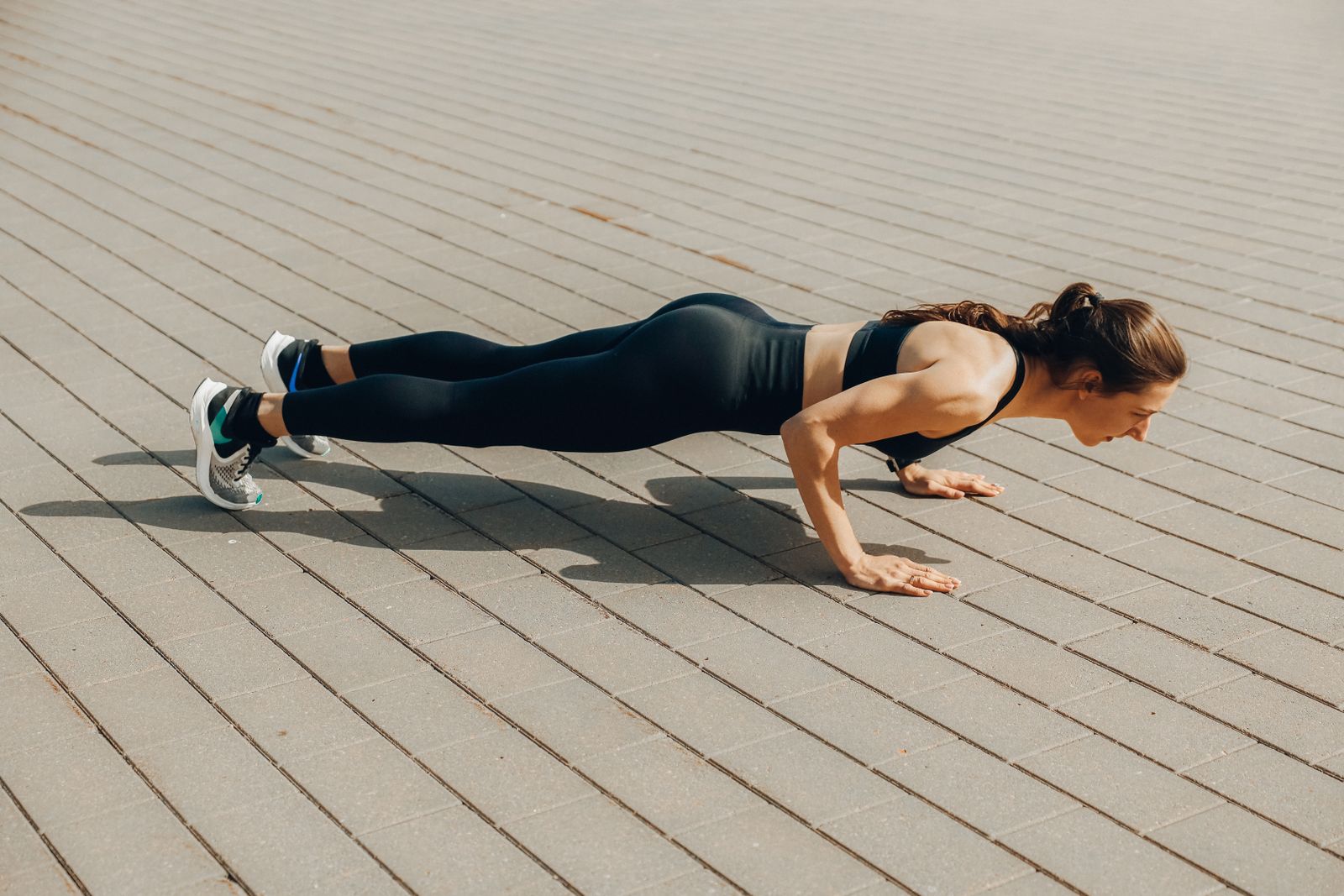
What actually makes your butt bigger?
The gluteus maximus makes up much of the muscle in your butt. The gluteus medius and minimus help move your leg outward and keep your pelvis stable. Resistance training can increase muscle size; body fat, pelvic structure, and muscle attachments also influence the outline you see.
This guide is for healthy adults who want to build muscle, whether at home or in a gym. The basic principles apply to men and women. Your starting strength, health, equipment, and preferences matter more than an internet body-type label.
Choose exercises by their job
You do not need every movement below in every session. Pick a small selection that fits your equipment and lets you work hard with consistent technique. Pairing a bridge with a hinge or squat is one useful way to plan your workouts; research does not show that this specific combination is required.
Training studies show that both squats and hip thrusts can build glute muscle. How an exercise feels, or how much electrical activity it produces in a muscle, cannot tell you which will lead to the most growth. The best option also has to be comfortable, practical, and progressively challenging.
| Job | Examples | What else to account for |
|---|---|---|
| Hip extension near the top | Hip thrust; floor glute bridge | Secure the load and bench. Finish by straightening your hips, not arching your back. |
| Hip extension from a bent-hip position | Romanian deadlift; squat; split squat | Hinges also train hamstrings. Squat patterns also train quadriceps and adductors. |
| Additional hip-extension work | Cable or band kickback | Keep your pelvis still; do not get extra range by bending your back. |
| Moving the thigh outward | Seated or side-lying abduction | An accessory option, not a replacement for all hip-extension training. |
A two-day beginner plan
For example, train Monday and Thursday. Warm up with easy movement and progressively heavier practice sets for the first lift. Practice sets do not count toward the working sets below. Start with lighter weights and stop each set when you think you could still do 2–3 more repetitions with good form. Learning to judge this takes practice; you do not need to push to your limit to find out.
This example contains 10 hip-extension working sets per week, plus two optional abduction sets. Treat it as a starting point, rather than an ideal amount of training for everyone. If you are new or returning, one working set per exercise can be enough to learn the routine before building toward the example. Keep strength training for the rest of your body in your schedule too; this plan covers only your glute work.
| Session | Exercise | Working sets × repetitions |
|---|---|---|
| A | Hip thrust or weighted floor bridge | 2 × 8–12 |
| A | Romanian deadlift | 2 × 8–12 |
| A | Supported step-up | 1 × 8–12 per side |
| B | Weighted floor bridge | 2 × 10–15 |
| B | Supported split squat or step-up | 2 × 8–12 per side |
| B | Cable or band kickback | 1 × 12–20 per side |
| A and B, optional | Seated or side-lying abduction | 1 × 12–20 each day |
Want a plan matched to your equipment and preferences? Use the Glute Workout Planner.
Make the next session slightly better
Keep your exercise setup consistent and choose a repetition range. For an 8–12 range, use the same resistance as you gradually add repetitions. Once you can do 12 in every planned set with the same technique and effort, try the smallest available increase in resistance. If you fall below eight clean repetitions, the jump was too large for this range.
A pause can help you repeat the movement consistently, but slowing down your repetitions can only do so much if the resistance is too light. Lifting more weight by shortening the movement does not tell you whether you have improved through the same range. Keep the exercise, bench height, range, and rest reasonably consistent.
| Session | Load (same units throughout) | Repetitions | Decision |
|---|---|---|---|
| 1 | 40 | 10, 9 | Keep the load |
| 2 | 40 | 11, 10 | Keep the load |
| 3 | 40 | 12, 12 | Try a small increase next session |
| 4 | 42.5 | 10, 9 | Build repetitions again |
Adapt the plan for home training
You do not need a bench for a floor bridge. Dumbbells make bridges and Romanian deadlifts easier to load; a band can add kickback or abduction resistance. A sturdy step can support step-ups if it is designed to hold you and your load without sliding or tipping.
With no equipment, begin with bridges, supported split squats, and side-lying abduction. As you get stronger, add repetitions or try a single-leg version you can control. Once an exercise is easy for many repetitions, more of the same may be an inefficient way to progress. Added resistance is an option, not a requirement to start.
| If unavailable | Try | Limit to watch |
|---|---|---|
| Hip-thrust bench | Floor bridge | Less range; you still need a secure loading position |
| Cable stack | Band kickback with a rated anchor | Use the same band tension and distance from the anchor each time |
| Abduction machine | Seated loop-band or side-lying abduction | Once the exercise feels easy, it can be harder to add more resistance |
| Heavy dumbbells | Supported split squat or single-leg bridge | Balance or pelvic control may limit the exercise before your muscles tire |
Eat to support the work
For most healthy exercising adults, about 1.4–2.0 grams of protein per kilogram of body weight daily is a reasonable general range. At 60 kg (about 132 lb), that is 84–120 g a day. You can cover it with ordinary food; a powder is only a convenience.
You do not have to begin with a large calorie surplus. Some beginners gain muscle while eating roughly enough to maintain their weight. If consistent training and meals are not supporting progress, a modest increase in food may help. A prolonged calorie deficit tends to limit gains in lean mass, including muscle. No food, supplement, or calorie target can send fat specifically to your glutes.
Recover and judge progress fairly
Leave at least a day between hard glute sessions initially. Focus on regular sleep and meals before adding another workout. Mild soreness can happen, but severe soreness or repeatedly struggling with your usual workout may mean you need to adjust how much you train. You do not need to chase pain to make progress.
Compare training logs across several sessions. If you take measurements or photos, keep the tape position, relaxed posture, camera distance, and lighting consistent. Avoid measuring right after a workout, when a temporary pump can make your muscles look larger. Your hip measurement reflects fat and fluid as well as muscle, so it cannot prove muscle growth by itself.
| Review point | Useful evidence | What it cannot promise |
|---|---|---|
| First few weeks | More consistent setup and repetitions, and more regular workouts | Early strength gains are not all new muscle |
| Around 8–12 consistent weeks | Workout progress and measurements taken under consistent conditions | A guaranteed visible transformation or centimeter target |
| Following months | Whether the same program remains productive | A fixed rate or another person's shape |
If your glutes are not growing, check the pattern
One weak workout is not a plateau. Look for a repeated problem under comparable conditions, then change one likely cause. A routine can be too easy or too demanding; adding sets is not always the answer.
| What you notice | First check | Next step |
|---|---|---|
| No rep or load progress; sets feel easy | Resistance and effort | Make the exercise challenging while preserving technique |
| Several lifts declining; persistent fatigue | Sleep, food, health, total workload | Reduce work or take an easier week before adding volume |
| Strength rising; appearance unchanged | Time and measurement consistency | Continue a full block; avoid reacting to daily photos |
| Thighs changing more than intended | Quad-dominant and hamstring work separately | Change the exercise mix and reassess over weeks |
| Pain, numbness, or sudden weakness | These symptoms need individual assessment | Stop the movement that triggers these symptoms and seek qualified assessment |
Should I add resistance next time?
Try the two-set, 8–12-repetition rule. Rest for a similar amount of time between sets and stop at your planned effort; this is not a test of maximal strength.
Keep the same resistance. Aim to add a clean repetition where possible until both sets reach twelve at the intended effort.
No entry is saved. Pain or injury needs individual assessment.
Common questions
Research and references
These references support the advice above. A general article still cannot account for your health, history, or individual response.
- American College of Sports Medicine (2026): resistance-training position stand
The current ACSM position stand summarizing resistance-training prescription for healthy adults.
- Currier et al. (2023): resistance-training prescription meta-analysis
A large network meta-analysis comparing combinations of load, sets, and frequency for strength and hypertrophy.
- Krause Neto et al. (2025): gluteus maximus hypertrophy review
Reviews direct muscle-size outcomes. Small and varied trials do not establish a universal exercise ranking.
- Plotkin et al. (2023): hip thrust versus back squat training
A nine-week study that reported similar measured gluteal hypertrophy between groups and greater thigh hypertrophy in the squat group.
- StatPearls: gluteus maximus anatomy and function
An NCBI Bookshelf clinical anatomy overview of the gluteus maximus and its roles in hip movement and stability.
- International Society of Sports Nutrition (2017): protein and exercise position stand
A position stand covering daily protein intake, meal distribution, protein quality, and supplementation for healthy exercising people.
- Morton et al. (2018): protein supplementation and resistance training
A systematic review and meta-analysis finding a modest additional benefit of protein supplementation during prolonged resistance training.
- Murphy and Koehler (2022): energy deficiency and lean-mass gains
A meta-analysis showing that prolonged energy deficits impair lean-mass gains during resistance training.
- Slater et al. (2019): energy surplus and muscle hypertrophy
A review of the evidence and practical uncertainty around using an energy surplus to support resistance-training adaptations.